Personal growth motivation for when you keep starting over
You started strong this time. Really strong. You had the plan, the energy, the commitment. You were going to change. And for a few days, maybe even a few weeks, you did.
Then something shifted. Life got busy. You got tired. You missed one day, then another. And suddenly you’re back where you started, wondering why you can’t make anything stick.
Real change doesn’t fail because you’re not motivated enough. It fails because most personal growth advice skips the part about how to actually make it last.
Lasting change isn’t about perfection or overnight transformation. It’s about building a system so simple and so solid that you can show up even on the days when you don’t feel like it.
This post will give you practical tips that actually work – a repeatable system for creating change that sticks.
Related reads
- Lost your motivation? How to feel motivated again and keep going
- Save your day: How to reset your day when it’s already going wrong
- The power of tiny moments: How 5 minute rituals can transform your life
- How to stick to personal goals when everything else has failed
- The power of affirmations: A complete beginner’s guide
- What’s blocking me? The 5 hidden barriers that keep you stuck (and how to finally break free)
Quick start (30 seconds)
Don’t have time to read the full post? Start here:
- Pick 1 focus area for the next 30 days (not your whole life)
- Choose 1 daily habit with a 2-minute minimum version
- Pick 1 bridge affirmation that feels believable
- Track it daily (mark an X, use an app, whatever works)
- Review weekly. Reset fast when you slip.
That’s the entire framework. Now let’s break down how to actually do it.
Start with your “why”
Before you pick a habit or set a goal, you need to know why this matters. Not the surface-level reason. The real one.
Most people skip this step. They pick goals that sound good or that they think they should want. Then they wonder why they can’t stay committed. Your personal growth journey needs emotional clarity. Without it, you’ll quit the first time it gets hard.
Ask yourself: What do I want to change, and why does it actually matter to me?
Not to your parents. Not to social media. To you.
The “pain vs. pull” exercise
Write down two things:
Pain: What is this pattern costing you right now? How will it feel if nothing changes in six months?
Pull: What does your life look like after this change? How do you feel? What becomes possible?
Be specific. “I want to be healthier” is vague. “I want to wake up without feeling exhausted and anxious” is real.
The clearer your why, the stronger your follow-through on your personal growth and development path.
Mini prompt
“If nothing changes for 6 months, what happens?”
Write it out. Let yourself feel it. That’s your starting point. Once your why is clear, the next step is making the change small enough to stick.

Personal growth and self development: Focus on one area
Here’s the trap that kills most people’s progress – they try to fix everything at once.
New year, new you. You’re going to eat clean, work out, journal, meditate, wake up early, drink more water, read every day, save money, and completely overhaul your career. Starting Monday.
By Wednesday, you’re overwhelmed, behind, and doing none of it.
The fix: Pick one priority for the next 30 days.
Not three. Not five. One. Choose the area that, if you made progress there, would make everything else easier or feel more manageable.
Examples of focus areas:
- Building confidence
- Improving discipline
- Managing emotions better
- Strengthening relationships
- Taking care of your health
- Getting your finances in order
- Moving your career forward
Pick one. Commit to it for 30 days. Master it. Then add another.
Quick worksheet: “My one focus this month is ___ because ___.”
Write it down. Make it visible. Let everything else be background noise for now.
Personal growth and development habits – start small
Big goals feel inspiring. Tiny goals actually get done.
The problem with “I’m going to work out for an hour every day” isn’t that it’s too ambitious. It’s that it’s too hard to repeat consistently, especially when life gets chaotic.
Real change happens through repetition, not intensity.
Your goal isn’t to do something amazing once. It’s to do something small over and over until it becomes automatic.
The “2-minute start” method
Make your habit so small it feels too easy to skip.
Not “exercise for 30 minutes.” Just “put on gym clothes.”
Not “write 500 words.” Just “write two sentences.”
Not “plan my whole week.” Just “pick tomorrow’s top priority.”
Real example: If you want to start journaling, your minimum version is opening the notebook and writing one line: “Today I feel…”
That’s it. The 2-minute version removes the friction. You’re not committing to the whole thing. You’re just committing to starting. And once you start, momentum takes over more often than you think.
Turn vague goals into clear actions
- “Get healthier” → “Walk 10 minutes after lunch”
- “Read more” → “Read 2 pages before bed”
- “Be more organized” → “Clear my desk every evening”
- “Save money” → “Transfer $10 to savings every Friday”
Track repetitions, not outcomes. You can’t always control the outcome. But you can control whether you showed up today.
This is the core of personal growth and self development that actually sticks.
Build identity-based habits (change who you believe you are)
What most people miss is that long-term change only sticks when it matches who you believe you are. You can force yourself to act differently for a while. But if it doesn’t align with your identity, you’ll eventually snap back to old patterns.
Old pattern vs. new pattern
Old: “I want to exercise more.”
New: “I am someone who moves their body.”
Old: “I should be more disciplined.”
New: “I am someone who keeps promises to myself.”
Old: “I need to get better at handling stress.”
New: “I am someone who handles hard feelings without exploding.”
See the difference? One is about wanting something. The other is about becoming someone.
Identity examples:
- “I am someone who keeps promises to myself.”
- “I am someone who handles hard feelings without avoiding them.”
- “I am someone who shows up even when it’s uncomfortable.”
- “I am someone who protects my energy.”
- “I am someone who finishes what they start.”
Simple daily identity vote
Every small action is a vote for the person you’re becoming.
One walk = one vote for “I am someone who moves their body.”
One boundary set = one vote for “I am someone who protects their energy.”
One day of tracking spending = one vote for “I am someone who makes intentional choices with money.”
You don’t need to believe it fully right away. You just need to cast the vote. The belief follows the evidence.

Personal growth motivation: Stop waiting to “feel ready”
Let’s talk about motivation. Most people misunderstand how it works.
Motivation is unreliable. And that’s completely normal.
You’re not broken because you don’t wake up excited to do the hard thing every day. You’re human.
The problem isn’t lack of motivation. The problem is thinking you need motivation before you can act.
Two types of motivation
Emotion-based motivation: The burst of energy you feel after watching an inspiring video or setting a new goal. It’s fast. It feels powerful. And it disappears within 48 hours.
Values-based motivation: The steady pull toward who you want to become. It’s slower. Less dramatic. But it doesn’t depend on your mood.
Real personal growth motivation comes from the second type. And you build it by acting even when you don’t feel like it.
The “do it messy” rule
Action creates motivation, not the other way around.
You don’t write because you feel inspired. You feel inspired because you started writing. You don’t work out because you feel energized. You feel energized because you moved your body.
Stop waiting to feel ready. Start messy. Start small. The motivation shows up halfway through.
What to do on low-motivation days
Don’t skip the habit. Just do the minimum version.
- Can’t do 30 minutes? Do 5.
- Can’t write a page? Write two sentences.
- Can’t do the full routine? Do one piece of it.
Lower your expectations. Keep the streak. That’s how you build something stronger than motivation.
Use personal growth affirmations the right way (so they don’t feel fake)
Let’s be honest – a lot of affirmations feel weird. “I am confident and powerful!” feels like lying to yourself when you’re anxious and stuck. Affirmations fail because they’re too big, too disconnected from where you actually are.
The better method: Bridge affirmations
Instead of jumping from “I feel like a failure” to “I am wildly successful,” use bridge statements that feel believable.
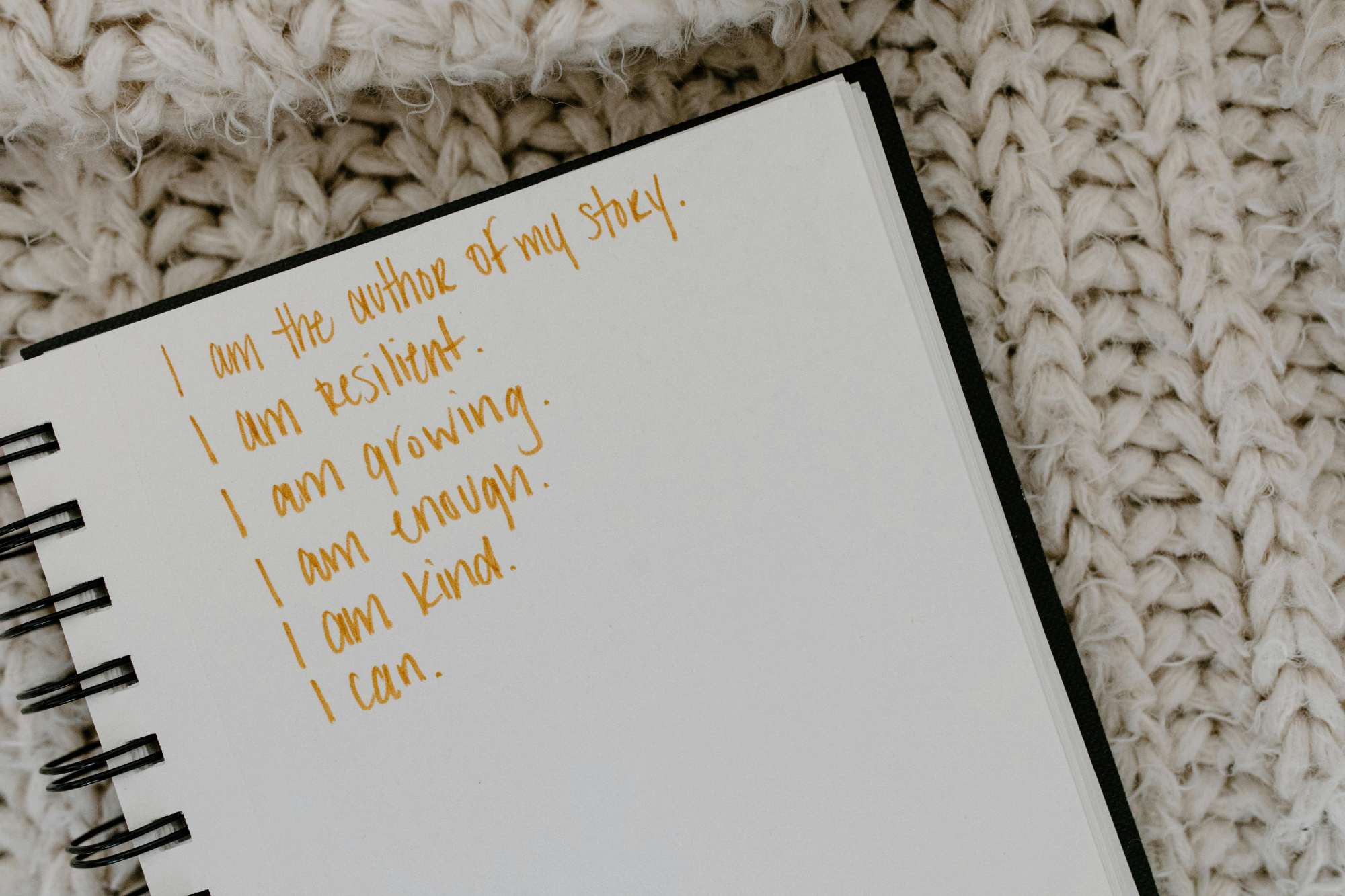
- “I am learning to trust myself.”
- “I am becoming the kind of person who follows through.”
- “I can take one small step today.”
- “I am building evidence that I can change.”
These work because they’re honest. They acknowledge you’re in process. They give you something you can actually believe.
10 personal growth affirmations for real life
Use these when the standard affirmations feel too fake:
- I can do hard things for two minutes.
- I don’t need to feel ready to start.
- I keep small promises to myself.
- My habits shape my future more than my mood does.
- Progress counts, even when it’s small.
- I can choose my next step.
- I can reset without quitting.
- I am allowed to grow at my own pace.
- I can learn from today instead of judging it.
- I am becoming more consistent every week.
Pick one. Write it on a sticky note. Put it somewhere you’ll see it when you’re about to quit.
Learn the “reset” skill
The skill that matters most isn’t staying perfect. It’s getting good at coming back. You’re going to slip. You’re going to miss days. You’re going to fall back into old patterns.
The difference between people who create lasting change and people who don’t? The reset skill.
The “all-or-nothing” trap
One missed day becomes “I ruined everything.”
One bad choice becomes “I already messed up, might as well give up.”
One slip becomes proof you’re not capable of change.
This is the trap. And it’s killing your progress.
Reset plan (use this every time you slip)
- Notice it. No shame. No spiral. Just: “I didn’t do the thing.”
- Name it. “I fell off the plan. That’s okay. It happens.”
- Restart with the minimum habit today. Not tomorrow. Not Monday. Today.
Do the tiniest version of the habit right now. Two minutes. One rep. One sentence. That’s the reset. That’s how you break the all-or-nothing cycle.
The 24-hour rule
Never miss twice in a row if you can help it. Missing once is life. Missing twice is the beginning of a pattern.
If you miss today, prioritize showing up tomorrow. Even if it’s messy. Even if it’s the minimum version.
The comeback is more important than the slip.
Grow your self-awareness (the real engine of change)
You can’t change patterns you don’t see.
Self-awareness is the skill that makes everything else possible. It helps you spot triggers before you react. It helps you understand what you actually need instead of what you think you should want.
Most people skip this step and wonder why they keep repeating the same cycles.
Identify your triggers
What consistently derails you?
- Stress makes you scroll for hours
- Boredom makes you snack mindlessly
- Certain people drain your energy
- Sunday nights fill you with dread
- Seeing other people’s success makes you feel behind
Write them down. You can’t avoid every trigger, but you can prepare for them.
Simple self-check questions
Ask yourself these throughout the day:
- What am I feeling right now? (Name it specifically)
- What do I actually need right now? (Not what you think you should need)
- What would help future me? (The version of you 3 hours from now)
These three questions interrupt autopilot mode and help you make intentional choices.
Weekly reflection (10 minutes)
At the end of every week, spend 10 minutes asking:
- What worked? (What made showing up easier?)
- What didn’t? (What got in the way?)
- What will I adjust? (One small change for next week)
This is how you learn from your experience instead of just repeating it.
Create an environment that makes growth easier
You can have all the willpower in the world. But if your environment is working against you, you’ll lose.
Your surroundings shape your behavior more than your motivation does. So design your space to make the right choice the easy choice.
Remove barriers
Make it easier to do the thing you want to do:
- Prep your gym clothes the night before
- Put your journal and pen on your nightstand
- Pre-cut vegetables so healthy eating takes zero effort
- Set up automatic transfers to your savings account
- Keep a water bottle on your desk
Add cues
Create visible reminders that trigger the habit:
- Calendar blocks for non-negotiable time
- Sticky notes with your affirmation
- A habit tracker on your wall
- Phone reminders at specific times
Make the “good choice” the easy choice
- Put the book on your pillow so you see it before bed
- Keep your phone charging in another room at night
- Unfollow accounts that make you feel behind or inadequate
- Delete apps you want to use less (make yourself log in on a browser)
- Keep snacks you’re trying to avoid out of the house entirely
You’re not fighting willpower. You’re building an environment where the habit you want is the path of least resistance.
Common mistakes that kill progress (and how to avoid them)
Before you build your plan, let’s talk about the predictable ways people sabotage themselves. If you can avoid these mistakes, you’re already ahead of most people.
Mistake 1: Choosing a habit that’s too big
You pick “exercise for an hour every day” when you haven’t worked out in six months.
Fix: Start with the 2-minute version. Build the showing-up muscle first. Intensity comes later.
Mistake 2: Tracking mood instead of reps
You ask “do I feel different?” instead of “did I do it?”
Fix: Track the action, not the feeling. Mark whether you showed up. Feelings are slow. Actions are immediate.
Mistake 3: Restarting only on Mondays
You slip on Tuesday and decide to “start fresh next Monday.”
Fix: Use the 24-hour rule. Reset today. Right now. The next right step is always available.
Mistake 4: Trying to change alone (no accountability)
You keep your goals private and have no one to check in with.
Fix: Find one person who’s also working on something. Text each other proof (not excuses). Weekly check-ins work better than daily ones.
Avoid these four mistakes and your chances of success go up dramatically.
How to start personal growth: Build a simple 30-day plan
Alright. You’ve got the principles. Now let’s build a personal development plan you can actually use.
Here’s a simple 30-day template. Copy it. Fill it out. Use it.
30-day personal growth plan
Focus area: ___ (Pick one. Just one.)
One habit (daily): ___(What’s the small action you’ll repeat every day?)
Minimum version: ___ (What’s the 2-minute version for hard days?)
Motivation anchor (why this matters): ___ (Your “pain vs. pull” answer)
Affirmation: ___ (Pick one from the list or write your own bridge affirmation)
Weekly check-in day/time: ___ (When will you spend 10 minutes reviewing what worked?)
Reward: ___ (Something small to celebrate at the end of 30 days)
Example filled out:
Focus area: Building discipline
One habit: Write for 10 minutes every morning
Minimum version: Write 2 sentences
Motivation anchor: I’m tired of starting projects and never finishing them. I want to prove to myself I can follow through on something that matters.
Affirmation: I keep small promises to myself.
Weekly check-in: Sunday at 9 a.m.
Reward: Buy that book I’ve been wanting
That’s it. Simple. Repeatable. Sustainable.
Your personal growth journey is built one day at a time
Real change doesn’t happen in dramatic transformations. It happens in small, repeated actions that slowly reshape who you are. You don’t need more information. You don’t need more motivation. You need something simple enough that you’ll actually use it.
Pick one focus area. Set one tiny habit. Choose one affirmation that feels true enough to believe. Track your proof. Reset when you slip. Review what’s working every week.
Now pick one thing from this post and do it today.
Choose your focus area. Write your “why.” Set your 2-minute habit. Pick your affirmation. Just do one thing. Right now. That’s how your personal growth journey moves forward. Not someday. Today.
Keep it simple, keep It going
If you take nothing else from this post, take this: lasting change is built from small actions done often. Not big promises. Not perfect weeks. Just simple reps.
You’re going to have messy days. That does not mean you failed. It means you’re human. The goal is not to stay perfect. The goal is to reset fast and keep going.
Here’s your next step:
- Write your focus area for the next 30 days.
- Choose one daily habit (with a 2-minute minimum).
- Pick one bridge affirmation.
- Start today, not Monday.
If you want accountability, share your focus area in the comments. I’ll be cheering for you, and you might help someone else start too.