

Best self-confidence affirmations for real confidence
Standing in front of the mirror saying “I am confident and powerful” while your inner voice mutters “yeah, right” doesn’t build confidence. It just points out the gap between where you are and where you want to be.
That’s the problem with most self-confidence affirmations, honestly. They ask you to believe something that flat out contradicts your current experience. Kind of like trying to convince someone it’s sunny out while they’re standing in the rain, soaked.
There’s another way to do this. Instead of faking a feeling you don’t have yet, you can build evidence that creates real confidence from the ground up. Not confidence you talk yourself into. Confidence you prove to yourself, one action at a time.
This is the version of self-confidence affirmations that actually sticks. It’s for anyone who wants affirmations that feel real, not fake or forced.
Related reads
- From self-doubt to self-trust: Why small promises build real confidence
- How to build a healthy relationship with yourself
- Practical guide to positive self-talk: Tips and techniques
- Journal prompts for confidence: Build real self-esteem through writing
- Daily self-confidence exercises to rebuild belief in yourself
- Self-trust vs self-confidence (and how to build both)
How self-confidence affirmations actually work
Positive self-talk gets a bad reputation, and honestly, it earns it half the time. Repeating “I am fearless” on a loop while your hands are shaking doesn’t rewire anything. Your mind notices fast when your words don’t match what’s actually happening. And when that happens, it usually believes what’s actually happening.
Do self-confidence affirmations really work?
Yes, but only when they’re anchored to something true. Affirmations for self-confidence work best as a mirror for evidence you already have, not a wish thrown at the universe. Research from the American Psychological Association suggests that self-affirmation exercises can support well-being and reduce negative mood.
Saying “I’ve survived every hard day so far” is something your brain can’t argue with. It’s just math. Saying “I am a magnetic, unstoppable force” while hiding in a bathroom stall before a meeting gets called out by your own nervous system immediately.
Why evidence-based affirmations work better
The brain believes what it sees repeated in real life, not what gets said out loud. Action creates that proof. Proof is what makes an affirmation feel believable instead of like a lie dressed up as encouragement. That’s the whole mechanism, and it’s simpler than it sounds.

The confidence evidence audit
Real confidence isn’t about convincing yourself you’re amazing. It’s about collecting proof that you can handle whatever shows up. Every time something scary gets survived, that’s evidence. Every time a failure gets followed by getting back up, that’s evidence too.
The goal isn’t to prove you were perfect. The goal is to prove you have already handled hard things.
Grab a notebook, your notes app, whatever’s closest. Start collecting.
What you’ve already survived
Write down five to ten hard things survived so far. Not things handled gracefully, necessarily. Things that got through, messy or not.
Maybe it was a breakup that felt like the actual end of the world. A new job with zero clue what was happening. Moving somewhere with literally no one around. A health scare. Standing up to someone genuinely intimidating. A financial mess that felt like it might sink everything. Speaking in public with a voice shaking so hard people could probably hear it. Getting criticized by someone whose opinion actually mattered.
Write the real list. Be specific. “I survived when…” Fill in the blank as many times as it takes.
Affirmation for this one: “I have a 100% track record of surviving difficult things.” Not motivational poster talk. Just true.
Skills built from nothing
List eight to twelve things doable now that weren’t possible before. None of it came pre-installed. It got learned, badly at first, probably.
Technology that used to be confusing as hell. Social situations that used to feel terrifying. Physical things that seemed flat out impossible. Professional skills built from zero. Creative work developed slowly, painfully, over years. Problems that somehow got easier to solve. Relationship skills only learned because it hurt to learn them the hard way.
Write the real list. Be specific about the before and the after.
Affirmation: “I’ve learned countless things that once seemed impossible.” True only after proving it with the list above.
Moments that came as a surprise
Think of five to eight times expectations got exceeded. The “I can’t believe that just happened” moments. The times someone said “I didn’t know you had it in you.”
Speaking up and having people actually listen. Taking a risk that paid off. Staying calm while everything else was falling apart. Solving something creatively when the obvious answer wasn’t working. Helping someone in a way that actually mattered. Finishing something faster than expected. Getting recognized for something privately doubted the whole time.
Write the surprise moments down. What happened that was shocking, even personally?
Affirmation: “I regularly surprise myself with what I’m capable of.” Again, true because it just got proven.
What are the best affirmations for self-confidence?
Honestly, the ones written after doing the exercise above. Generic affirmations for self-confidence pulled off Pinterest don’t know anyone’s specific survival stories. A personal evidence file does. The best affirmations about confidence come from proof already collected, not somebody else’s script.
If self-belief feels like it’s running on empty right now, start with the exercise. Skip the empty mantras.
What if the affirmations don’t feel believable yet?
That’s normal, and it’s not a sign anything’s broken. Start smaller. Instead of “I am confident,” try “I’m learning to trust myself more each day.” Instead of “I’ve got this,” try “I can handle this one step at a time.” A believable affirmation does more work than an impressive one that feels like a lie every time it gets said.
Once there’s proof from the past, the next step is building new proof in real time.

The confidence stack: One small win at a time
Confidence doesn’t come from one grand gesture. It comes from a stack of small wins that prove, over and over, that trust is deserved here. For the deeper mechanics behind why this works, the piece on why small promises build real confidence gets into the psychology.
Weeks 1 and 2: Micro-confidence builders
Pick 3 to 5 and do them this week. Write down what actually happened, not what got planned.
Make eye contact with three people. Say an actual opinion out loud, once. Wear the thing that feels good. Walk into a room like belonging there is a given. Ask one question in a meeting. Give someone a real compliment. Stand up straight through an entire conversation, on purpose.
What gets written down: “This week, [specific action] happened even though it felt uncomfortable.”
Daily affirmation: “I build confidence through small, brave actions every day.”
Weeks 3 and 4: Mini challenges
Choose 2 or 3 and complete them. Write down exactly what happened, not the polished version.
Speak up when something feels off. Make the phone call that’s been avoided for weeks. Introduce yourself to someone new. Share an idea that might get rejected. Ask for what’s actually needed, directly. Set a boundary without the three-paragraph apology attached. Take credit for something done well, out loud.
What gets written down: “[Specific challenge] happened, and here’s what got learned in the process.”
Weekly affirmation: “I take action despite fear because action is what builds confidence.”
Should affirmations get said every day?
If they’re paired with action, yes, daily works well. Saying the affirmation right before or after doing the thing reinforces the connection the brain is trying to make. Saying it alone, with nothing behind it, just becomes background noise that gets tuned out fast. Pair the words with the proof, every time.
Weeks 5 and 6: Stretch moves
Pick 1 or 2 bigger challenges here. Scary but doable, not “call in sick to avoid it” scary.
That difficult conversation that’s been postponed for a month. Applying for something without being sure of qualifying. Sharing work publicly. Negotiating for something wanted. Leading a meeting instead of hiding in the back of it. Admitting out loud to not knowing something. Asking for feedback on actual performance.
What gets written down: “[Specific challenge] got taken on, and here’s the evidence created.”
Affirmation: “I seek challenges that help me discover what I’m capable of.”
Weeks 7 and 8: Confidence flexing
One big challenge, the kind that’s genuinely scary. Plan it, do it, then actually celebrate it instead of moving the goalpost.
Giving a presentation. Starting a project without certainty of finishing it. Sitting down with someone genuinely admired. Taking on a leadership role. Telling a personal story publicly. Making a big decision quickly instead of circling it for weeks. Defending a position when someone pushes back.
What gets written down: “Something scary happened: [specific action]. Here’s what got learned about what’s handle-able now.”
Affirmation: “I trust myself to handle whatever comes from being bold.”
None of this works without room for the fear that shows up alongside it.

Confidence isn’t the absence of fear
Real confidence doesn’t mean feeling nervous, uncertain, or scared disappears. Confidence is the willingness to act while all of that is still very much present.
Confident people feel nervous before presentations too. Self-doubt shows up at the start of new projects for them as well. Worry about being judged happens right before sharing an idea, just like for everyone else. The difference isn’t fear’s absence. It’s doing the thing anyway.
Why do affirmations sometimes not work?
Usually because they’re trying to erase fear instead of working alongside it. “I am fearless” is a lie the nervous system won’t buy. “I can feel scared and still take action” is a promise the nervous system can actually keep. That one shift, from erasing fear to acting through it, changes everything about how affirmations land.
True confidence affirmations, worth actually using:
- “I can feel scared and still take action.”
- “I don’t need to feel confident to act confidently.”
- “My nervousness is proof I’m pushing my comfort zone.”
- “I trust myself to figure things out as I go.”
- “I’m allowed to be imperfect and still valuable.”
Pairing these with self-trust affirmations helps too. Trusting yourself is the foundation everything else gets built on.
Action creates confidence, not the other way around
Confident people weren’t born that way. It was built by doing confident things before the feeling showed up. That order matters more than anything else in this article.
Acting brave comes first. Feeling brave comes after. Asking for what’s wanted comes first. Feeling worthy comes after. Taking the risk comes first. Feeling ready comes after.
This is exactly why traditional affirmations fail so often. They try to manufacture the feeling before there’s any evidence to back it up. Real confidence gets built backwards: evidence first, feeling second, always.
The evidence-to-confidence plan
Take one small action that requires a little courage. Acknowledge that it happened. Write it down, don’t just think it. Use that evidence to take a slightly bigger action. Acknowledge that one too. Repeat until confidence stops being a performance and starts being the default state.
Affirmation: “I build unshakeable confidence through consistent, courageous action.”
Beyond affirmations: What confidence actually needs
Affirmations work when they’re backed by evidence and action. That’s everything this article has been building toward. But lasting confidence needs more than positive self-talk alone.
It needs a way to handle rejection without it wrecking your self-worth. Skills for speaking up when the room’s quiet and everyone’s waiting. A way to make decisions fast instead of spiraling.
It means trusting yourself in situations never faced before. Recovering quickly when a plan falls apart. Holding onto confidence even when people doubt you.
Real confidence comes from both mindset and practice. With both, confidence stops being something you tell yourself. It becomes something you just know.
None of this replaces therapy or coaching when deeper patterns are at play, especially around anxiety, trauma, or persistent self-worth struggles. Affirmations and evidence-building are tools for everyday confidence, not a substitute for professional support when that’s what’s actually needed.
Knowing what works is only half of it. Worth knowing what quietly breaks it too.
Common mistakes people make with self-confidence affirmations
Most affirmation habits fail for the same handful of reasons. Worth checking against this list before writing off the whole practice.
Repeating a line that isn’t believed at all, not even a little. Saying the words without pairing them with any action. Choosing something vague like “I am enough” with no specific proof behind it. Quitting after three days because nothing felt different yet. Only reaching for affirmations when things already feel bad, instead of building the habit on ordinary days too.
Any one of these can make the whole practice feel fake. Fix even one, and the words start carrying more weight. If your affirmation feels fake, it’s usually too big, too vague, or not connected to action yet.
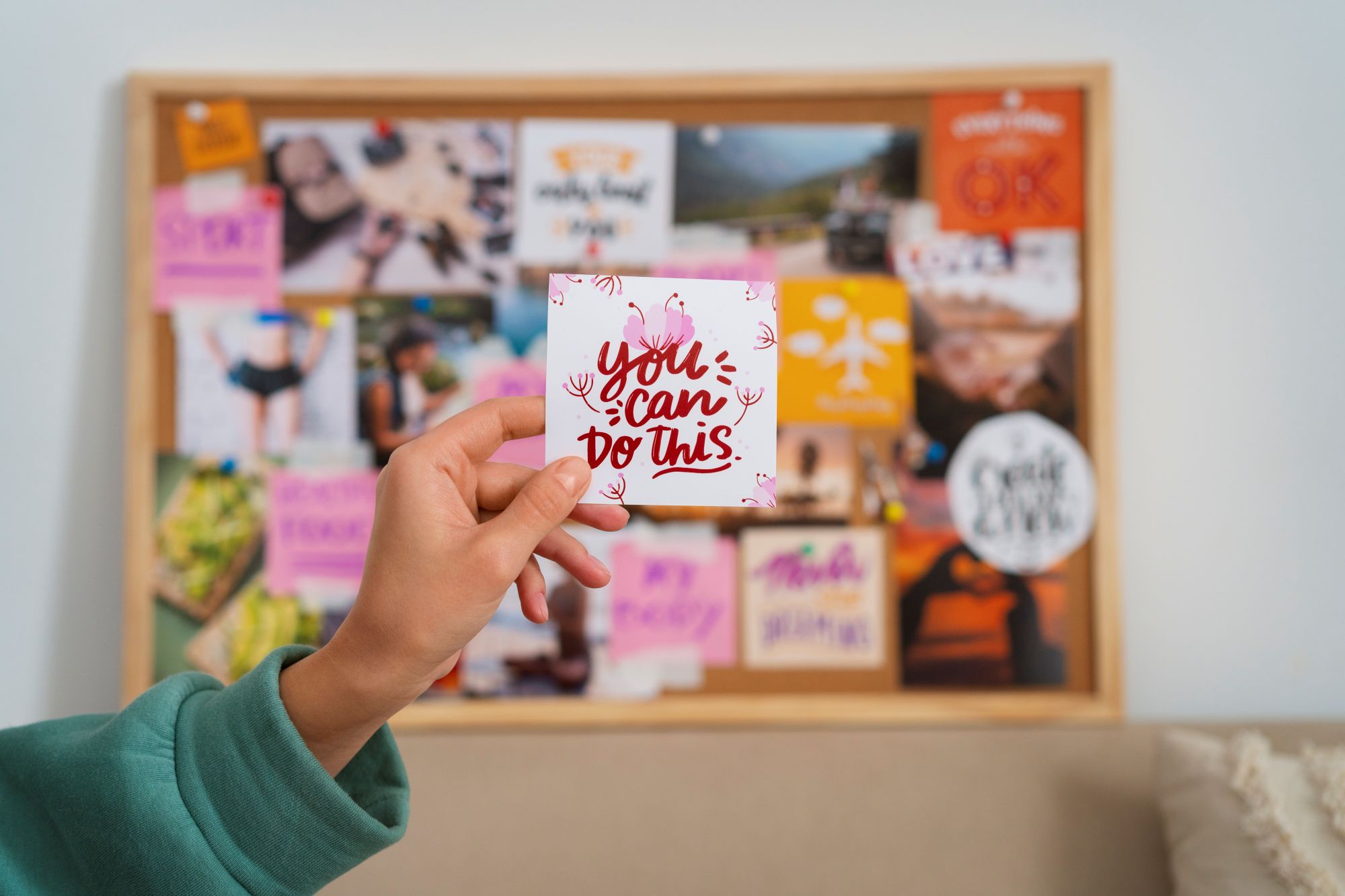
How to use self-confidence affirmations the right way
Notice one specific area where confidence feels shaky right now. Pick an affirmation that feels believable, not aspirational. Pair it with one small action that same day. Write down the proof after doing it. Repeat with a slightly bigger step next time.
That’s it. No perfect morning routine required. Mornings work well for some people, evenings work better for others who like reviewing the day’s proof before bed. The timing matters less than the pairing between words and action.
Start with one area: speaking up, setting boundaries, or trusting your own decisions. Pick one lane before trying to fix everything at once.
Examples of self-confidence affirmations that feel real
Pairing the words with a matching action is what makes these work. A few starting points:
- “I can handle this one step at a time.” Action: send the email that’s been sitting unanswered.
- “I’ve done hard things before.” Action: write down three hard things already survived.
- “I don’t need to be perfect to begin.” Action: start the thing before it feels ready.
- “I can feel nervous and still move forward.” Action: speak up once in the next meeting.
- “I’m learning to trust myself more each day.” Action: keep one small promise made today.
- “I can learn as I go.” Action: start before every detail is figured out.
- “I don’t need to rush to prove myself.” Action: take the slower, steadier path on one thing today.
- “Small steps still count.” Action: log the smallest win from today, no matter how minor it feels.
Notice none of these claim certainty or perfection. They claim capability, which is a much easier thing to actually believe once there’s proof behind it.
Self-confidence affirmations you can actually use
Then give affirmations that match the article’s message, like:
- I can feel scared and still take action.
- I have handled hard things before.
- I do not need to be perfect to begin.
- I trust myself to figure things out as I go.
- I can take one small step at a time.
- I am learning to believe myself more.
- I can do hard things even when I doubt myself.
- I am building confidence through action.
Your starting point
Right now, before closing this tab: write down one thing that took even a tiny bit of courage this week. Maybe it was an email that felt dreadful to send. Maybe it was wearing something bold. Maybe it was speaking up once in a moment that usually stays quiet.
Write it down. Look at it. That’s evidence. That’s proof hard things are doable.
Now think of one small thing tomorrow could hold, something that asks for slightly more courage than today’s did. Not something huge. Not something terrifying. Just something that stretches things a little.
That’s the next piece of evidence.
Confidence isn’t built through what gets said to a mirror. It’s built through what happens when nobody’s watching. The affirmations that actually work are honest, specific, and backed by action, nothing more complicated than that.
What evidence gets created tomorrow?
Feeling like a fraud in the moments that matter gets old fast. So does second-guessing every decision. If actually trusting yourself, not just talking about it, is the goal, scattered exercises alone won’t get there.
Real self-confidence affirmations work best when they’re believable, specific, and paired with one small action.
If affirmations alone aren’t enough, the Confidence workbook can help turn courage and self-trust into real habits, not just another list of things to say to yourself.
Waiting to feel confident someday can stop right here. Building the evidence that makes it inevitable starts now.