
Self-care for busy people: Simple micro-care that actually works
At some point, my self-care list looked like this: morning pages, meditation, exercise, skincare routine, healthy breakfast, evening wind-down, gratitude journal, habit tracker.
Exhausting just reading it back.
One morning I opened my phone to check what self-care tasks I had left for the day and felt this wave of stress. Actual stress. About self-care. And then I laughed, because what had gone so wrong that relaxing had become something I could fail at?
That was the moment everything shifted for me. Somewhere between the wellness content and the perfect routines, self-care had stopped being something I did for myself and become something I did to myself.
If that sounds familiar, this post is for you.
Self-care for busy people doesn’t need to be elaborate. It needs to be real. Small. Woven into the day you actually have, not the curated version you’re still waiting to arrive at.
Related reads
- How to create a self-love routine that fits your daily life
- The power of tiny moments: How 5 minute rituals can transform your life
- Stop earning self-care: Simple self-care activities that help you rest without guilt
- What to do on days with no energy: Your minimum baseline routine for low-energy days
- How to build a healthy relationship with yourself
Why traditional self-care feels impossible (and why that’s not your fault)
Most self-care content is built for people who already have margin in their days.
When you’re genuinely busy, whether that’s building something, raising kids, carrying the invisible mental load of keeping a life running, the standard advice creates another task. Another thing to feel guilty about skipping.
And here’s the sneaky part: when self-care becomes another obligation, it stops being care at all.
A mum who gets 20 minutes to herself per day doesn’t need a twelve-step skincare ritual. A remote worker eating lunch between back-to-back calls doesn’t need a 45-minute yoga flow. Someone who’s mentally depleted by 6pm doesn’t need emotional excavation in a journal.
They need something small. Real. Accessible today, not when life calms down.
The pressure to do self-care right is the actual problem. So here it is, from someone who used to stress about her self-care routine: permission to do it differently.
What micro-care actually means
Micro-care is not watered-down self-care. It’s self-care that understands how real life works.
A glass of water before coffee. Three slow breaths before the next task. Shoulders down, jaw unclenched, for just a moment. One minute sitting down before you’re completely collapsed.
Not aesthetic. Not optimized. Just staying in contact with yourself throughout the day, instead of going completely numb and calling it getting through it.
The goal is accessibility. Something so small that you can actually do it today. As things are.
The best self-care habits for busy people
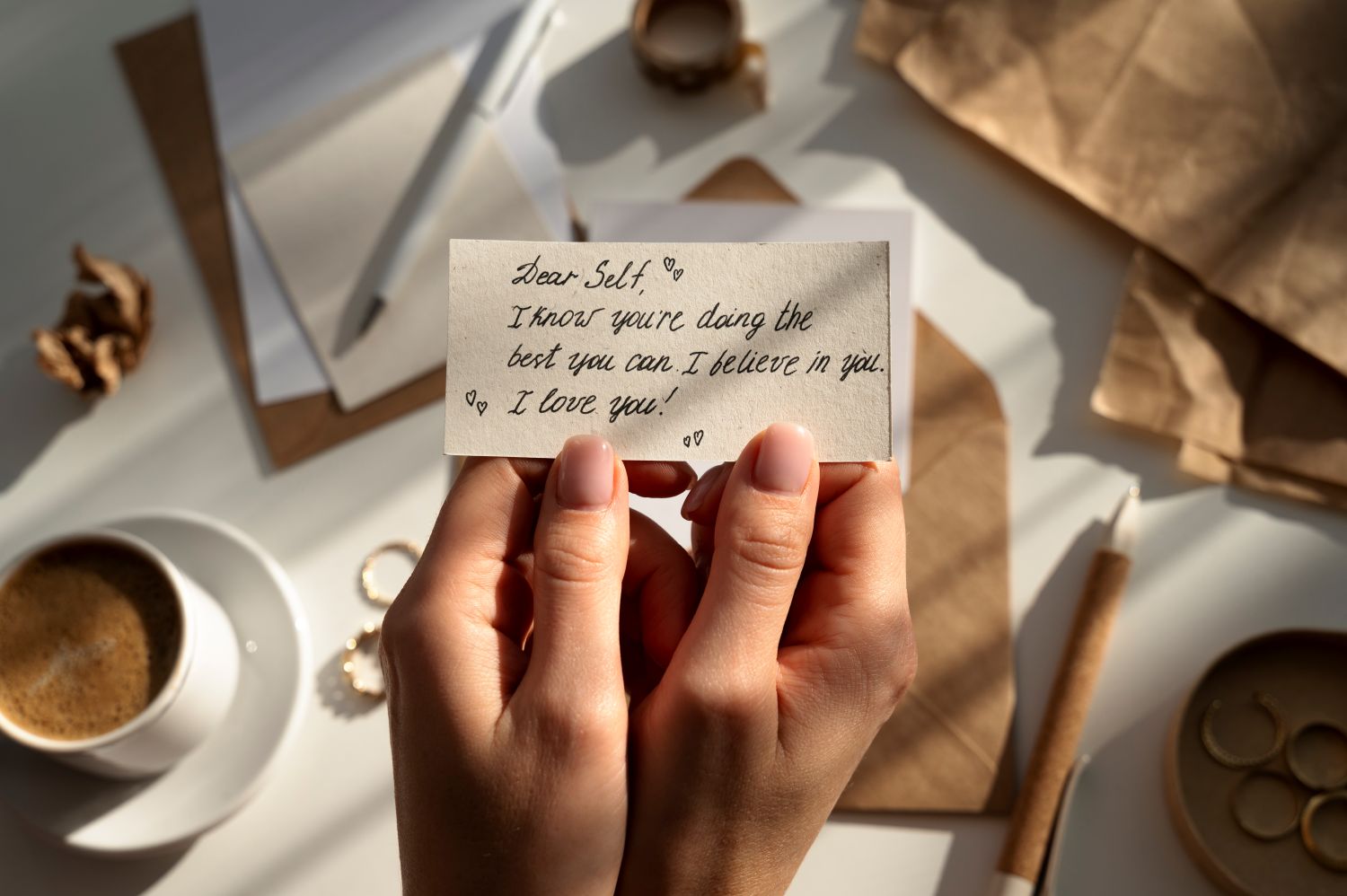
These aren’t habits that require a schedule overhaul. They’re small shifts that slot into the day you already have.
Start the day with one tiny thing that’s just for you
Before the first email. Before checking your phone. Before you’re already three steps behind.
One tiny thing. Drink water. Open the curtains. Stand in the kitchen for two minutes without doing anything useful.
A mum of two I know makes her coffee, sits down for three minutes before anyone else is up, and just exists. No journaling. No intentions. Just three minutes that belong to her. She says it changes the whole morning.
Starting your day with even one moment that’s yours sets a different tone than starting in immediate reaction mode.
Build care into what you already do
Busy people aren’t adding new time blocks to their day. But they can change what happens inside time that already exists.
Brushing your teeth? Actually breathe. Waiting for a page to load? Stretch your neck. Commuting? Put on something that makes you feel good instead of the news. Washing your hands? Use the lotion after. Slowly. Like it counts.
Not a single extra minute added to your day. Just existing minutes that feel different.
Protect your energy with the smallest boundaries
When time is limited, energy leaks become expensive.
That means not answering every message the second it arrives. Letting a non-urgent call go to voicemail. Saying “let me think about that” instead of automatically saying yes.
A friend who works full-time and runs a side business started turning off notifications for one hour after work. Not a full digital detox. Just one hour. She said it felt radical for a week, then it just felt like hers.
Micro-boundaries don’t require hard conversations. Just a small pause before giving your time away automatically.
Make rest easier to reach
Most people don’t rest because rest requires setup. The couch is covered in laundry. The bedroom is too bright. The phone is right there.
Lower one barrier. Keep a blanket on the sofa. Put your phone across the room before bed. Dim the lights an hour before you want to sleep.
Small environmental shifts change what you actually do. Your tired future self will thank you.
Let self-care be different on different days
Some days it’s movement. Some days it’s stillness. Some days it’s a meal you actually sit down for. Some days it’s canceling the plan you weren’t looking forward to anyway.
The question is always just: what does this version of me actually need right now? Not what looks like self-care. Not what worked for someone else. What do you actually need today?
Getting good at asking that question is the whole practice.
Quick self-care ideas for busy people (5 minutes or less)
Keep this list. Come back to it when you have five minutes and no idea what to do with them.
- Drink a full glass of water, slowly
- Step outside for fresh air, even just to the doorway
- Stretch your neck and roll your shoulders
- Put on one song that makes you feel like yourself
- Tidy one small surface – not everything, just one
- Sit down and close your eyes for 60 seconds
- Write down one thing you actually need right now
- Wash your face slowly, like it’s not a task
- Take three deep breaths, real ones, where your belly moves
- Step away from your screen and look at something far away for one minute
None of these are impressive. That’s exactly the point.
How to make self-care a habit when life is busy
The trick isn’t willpower. It’s attachment.
Find something you already do every single day without thinking. Coffee. Brushing teeth. That transition moment when work ends and home begins. Attach something tiny to it.
After coffee → drink a glass of water. Before bed → phone face-down for ten minutes. When work ends → change clothes, take three breaths, actually arrive home instead of just physically moving locations.
Habit stacking works because it removes the decision entirely. When the existing habit triggers, the new one follows.
Start small enough that it feels almost embarrassingly easy. That’s not low ambition. That’s strategy. A two-minute practice you actually do beats a thirty-minute practice you keep postponing. Every single time.
What self-care is not
Self-care is not another pressure. If your self-care routine is stressing you out (been there, it’s a specific kind of irony), something has gone sideways.
It’s not a luxury for when life settles down. It’s what keeps you functional when life is hard. It’s not about buying the right products or documenting it for anyone.
And it’s not something you earn by doing enough first. Rest is not a reward. It’s maintenance. You’d never tell your phone “you can charge after you get me through the day.” That’s not how any of this works.
A simple self-care plan for busy days
Three small anchors across your day. That’s it.
Morning
Water before anything else. One minute before checking your phone.
Midday
Three slow breaths. A quick shoulder stretch. A brief honest check-in: how are you actually doing?
Evening
One calming thing. Not productive, not optimized. Phone down ten minutes earlier than usual.
Start here. See what it does before deciding it’s not enough.
The honest truth about self-care for busy people
Self-care for busy people isn’t about fitting more in. It’s about actually inhabiting the moments you’re already moving through.
The difference between rushing through getting ready and taking thirty extra seconds to be a person doing that. Between eating standing at the counter and sitting down, even just for five minutes.
The moments are already there. Micro-care is just choosing to be present in them instead of running straight through them.
It doesn’t require more time. It requires a little more intention. And some days, it requires reminding yourself that you’re worth the two minutes.
And if you’re someone who read all of this and still feels a little guilty about slowing down? That’s okay. That’s actually really common. It doesn’t mean the tips won’t work. It just means there’s a layer underneath worth being curious about.
For now, just pick one thing. Start there. And if you want to share which one you picked, leave a comment below. Hearing what actually resonates helps me write more of what you need.